


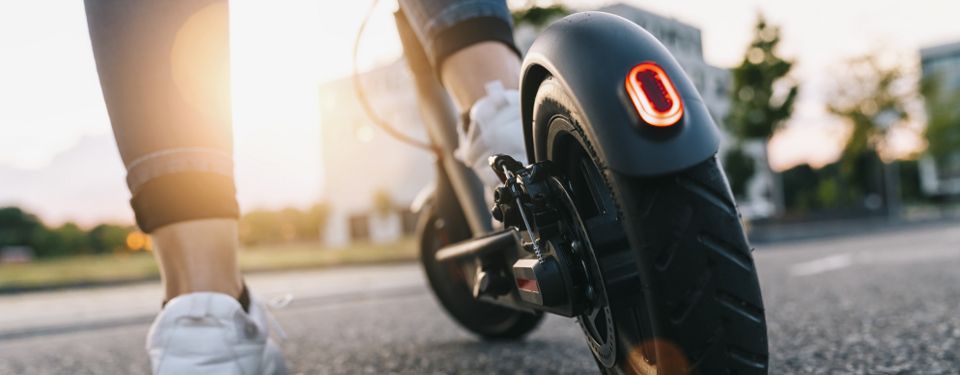
Electric Scooters (E-scooters) are a popular way to get around quickly and conveniently. The use of this means of transport is regulated by law and is not entirely risk-free.
Accidents involving e-scooters continue to occur and the police regularly detect scooters exceeding the permitted maximum speed of 25 km/h. In doing so, riders endanger not only themselves but also other road users.
Micro electric vehicles (MVE)
According to the Road Traffic Regulations, e-scooters are classified as micro electric vehicles (MVE), as are, for example, hoverboards. MVEs are small road vehicles with at least one wheel, with or without a seat, designed for the transport of a single person, and:
- are powered exclusively by an electric motor with a maximum continuous rated power of no more than 1000 W;
- have a design speed exceeding 6 km/h;
- may not exceed a maximum design speed of 25 km/h.
What traffic rules apply?
Like all other road users, riders of e-scooters must comply with the generally applicable traffic regulations.
Depending on the type of vehicle, the rules regarding age and where it may be used can differ.
Generally speaking, however, children under the age of 10 are not allowed to drive a vehicle on public roads, unless they are on their way to or from school or are on private property. However, children under the age of 10 are not permitted to drive an MVE on public roads!
Personal mobility devices (EDP)
(maximum design speed ≤ 6 km/h)
- Children under the age of 10 are not allowed to drive a vehicle on public roads, unless they are on their way to or from school or are on private property.
- Children aged 10 to 13 may ride on pavements, designated pedestrian paths, designated shared pedestrian and cycle paths, recommended shared pedestrian and cycle paths, farm roads, paths in public parks, as well as in residential areas and pedestrian zones. The condition is that they do not endanger themselves or obstruct or endanger other road users.
- The aforementioned routes also apply to persons aged 13 and over who are cycling to accompany one or more children under 13 years of age.
Additionally:
- Children aged 10 and over may ride on public road sections marked with traffic signs “C2”, “D4”, “E18a” or “F19a”, supplemented by additional sign Model 6b.
- This also applies to children under 10 years of age, provided they are accompanied by a person who is at least 15 years old.
Micro electric vehicles (MVE)
(maximum design speed > 6 km/h ≤ 25 km/h)
- Children under the age of 10 are not permitted to drive an MVE on public roads.
- Children aged 10 to 13 may ride on pavements, designated pedestrian paths, designated shared pedestrian and cycle paths, recommended shared pedestrian and cycle paths, farm roads, paths in public parks, as well as in residential areas and pedestrian zones.
- The above-mentioned routes also apply to persons aged 13 and over, provided that they are accompanying one or more children under the age of 13.
It should be generally noted that parents are liable for their children in the event of a violation!
Equipment
The equipment requirements for micro electric vehicles differ from those for bicycles with regard to lighting:
- If it is technically impossible to install side reflectors on to the micro electric vehicle, reflective bands or other reflective devices must be fitted on both sides of the vehicle or worn by the rider.
- The lighting systems fitted to micro electric vehicles must be switched on both during the day and at night.
- In conditions of reduced visibility, from dusk until dawn, and during the day when atmospheric conditions require it, the red rear lights must be clearly visible at a height of at least 40 cm above the ground. If the vehicle is not equipped with such lights, equivalent lights may be attached to the rider.
Mandatory equipment also includes:
- a bicycle bell;
- a braking system;
- a white, non-flashing front light;
- a red, non-flashing rear light.
In addition, the MVE must not exceed 1.50 m in length.
What else needs to be considered?
- Wearing a helmet is strongly recommended but not mandatory.
- Wearing reflective clothing is strongly recommended. It is only mandatory if it is technically impossible to attach reflectors to the vehicle.
- Registration is not required in Luxembourg. Damage caused by or through micro electric vehicles is generally covered in Luxembourg by private liability insurance (Responsabilité Civile Vie Privée). Parents are liable for their children.
- E-scooter riders must signal when changing direction (just like cyclists).
What is prohibited?
- Transporting passengers;
- Towing.
Driving under the influence of intoxicants
The alcohol limit is 0.5‰ for persons aged 18 and over. For drivers under the age of 18, the limit is 0.2‰.
Furthermore, a maximum limit of 1 ng/ml blood applies when driving vehicles under the influence of THC.
Tuning
Many e-scooter owners are tempted to tamper with their scooters' maximum speed. This is considered a misdemeanour and always results in a police report being filed, as well as possible confiscation of the scooter. It may also have far-reaching criminal consequences, as the vehicle may, depending on the offence, become subject to registration, licensing and insurance requirements.
Police controls
As with all other road users, the police carry out regular controls on users of micro electric vehicles to ensure that they ride safely and in compliance with the law:
- Multiple offences during traffic controls in Luxembourg City (Mehrere Verstöße bei Verkehrskontrolle in Luxembourg-Stadt)
- Multiple offences during traffic controls in Luxembourg City (Mehrere Verstöße bei Verkehrskontrollen in Luxembourg-Stadt)
- Inspection of food delivery drivers in Luxembourg-City (Kontrolle von Fahrradlieferanten im hauptstädtischen Bahnhofsviertel)
- Press release from the Luxembourg Public Prosecutor's Office regarding a traffic control of electric scooters
- ...
This article is intended for informational purposes only and has no legal standing.